
Be More Weeble
Resilience. The bedrock.


One of the things I have observed and found fascinating in many years at work (and in life) is the incredible “bouncebackability” that some people seem to have. Whatever happens to them, they take the impact, recover from it, and somehow emerge even stronger. They don’t ignore or minimise whatever the thing is that’s knocked them for six, and it might take some time to recover. But recover, they do.
People like this remind me of the curiously fabulous 1970s toy - the Weeble. These were small, egg-shaped figures that thanks to a counterweight in their base, would always return to an upright position no matter how violently you tried to knock them off course. I have no idea how someone came up with this concept. Perhaps Dave at Hasbro just woke up one morning and went FML people, I know what the world needs….
Note. I don’t remember them looking quite as sinister (or as much like Donald Trump) as they do in this photo, but I’ve clearly blanked that part from my memory.
Anyway, trying to perform well at work or in life without a solid bedrock of resilience is nigh on impossible, so for me it’s been a key skill to try and develop. And when it comes to Weeble like resilience, turns out there are strategies that you can deploy to build the muscle, just like you would any other at the gym. (I don’t go to the gym btw, as I CBA. But I admire people who do).
And when you want to think about strategies for surviving the toughest moments, I wouldn’t bother with textbook business theory. I wouldn’t even turn to the resilience of amazing Olympic medal winning sports people or mountaineering adventurers, admirable as they are.
For lessons in deep, transformational resilience I’ve found the most helpful stories and tools have come from the grief community. The death of someone you love is probably one of the hardest things that any of us will ever go through, so the grief gang (and sadly, I am one of them) know the real deal.
Dr Erin Thompson at The Loss Foundation has some fabulous and very affordable online content and tools, including this powerful one hour seminar on Resilience Training
I’ve adapted her thinking, along with my other research into resilience, into a ten minute reflective exercise that I use with myself and my teams. It’s just two slides - an overview of four resilience pillars, and five reflective questions. Some writers add a fifth pillar along the lines of spirituality or purpose. Others have four pillars but with slightly different wording. Google away if mine doesn’t quite resonate and you’re bound to find one that does. Anyway…
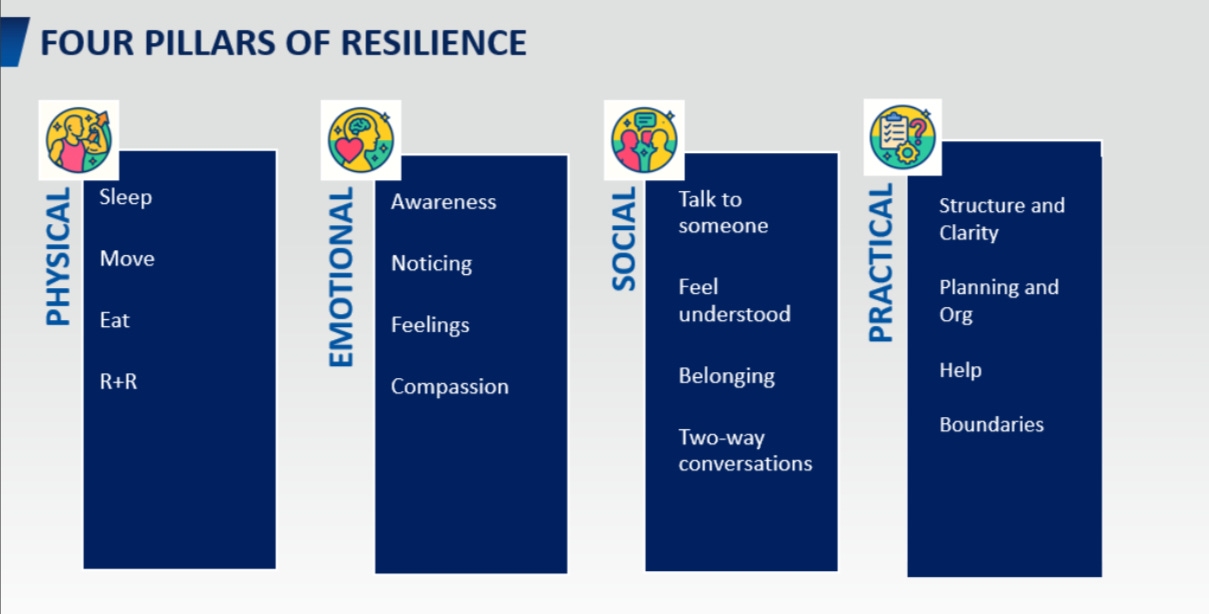
The pillars invite you to think about the factors that underpin your resilience, from the physical through the emotional, the social and the practical. You can think purely about the context of work, or about the whole of your life, depending on how you’re feeling or what you need. It’s amazing how helpful this simple structure is.
My reflective questions are these…
Audit yourself against the four pillars. On a scale of 1-10, how are you doing on each pillar right now?
Within each pillar, which elements are working well for you?
Within each pillar, which elements are working less well or feel a bit neglected?
Therefore, what do you need to Stop/Start/Continue in the coming weeks and months?
Who can help you? What do you need from your colleagues, your partner, your boss, anyone else?
So give the four pillars of resilience a try this week and let me know how you get on. What do you find helpful about the approach? What would make it even better? What other tools and resources on resilience do you have in your kit-bag?
Comment away…
Footnote. Erin herself is an inspiration, and I don’t think it’s any accident that her middle name is Hope. A clinical psychologist by trade, she founded The Loss Foundation in 2012 after witnessing the lack of support that was available when her father died from cancer. As a result, she was awarded an MBE for Services to Bereaved Families.
The Loss Foundation website also does a range of fantastic cards that avoid either the chasm of silence or the creepy platitudes that typically happen when someone is grieving. Cards like this…

Buy them here to support a fantastic charity Swear in Solidarity
If you’re a corporate type or an HR Pro, the Loss Foundation also offer great support to organisations to help managers and colleagues support one another through grief. Check them out online.
Love the four pillars - saving this image and auditing myself NOW! Will also check out the Loss Foundation - sounds like something I would resonate with xx
Defo be more Webble - I shall repeat as a mantra for my recovery.