
Johari's Window
and the Existential Poetry of Donald Rumsfeld.

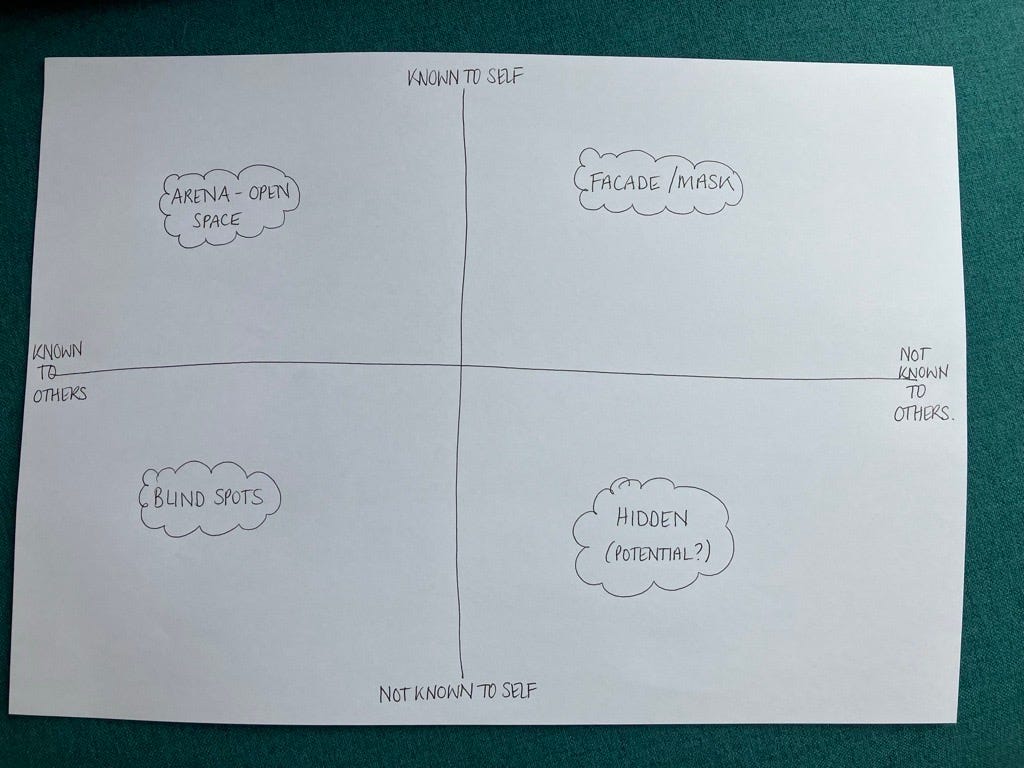
It’s cold, grey and endlessly raining where I am at the moment, so you probably don’t want to look out of the actual window in case it makes you want to curl up in a corner and cry as we enter the 746th day of January.
But lo, I bring good news, for just such days there’s an alternative inner window you can look through instead 🙌 Johari’s window isn’t really a window at all, but a matrix. But if you draw a matrix I suppose it does look something like a traditional four-paned window like the ones a child would draw on a house. Anyway, I digress.
Johari’s window sounds instantly fascinating. When I first heard about it, I knew just by its name that it would bring deep, ancient wisdom from the ayurvedic or yogic tradition. I imagined stunning South Indian beaches, Surya Namaskar, elephants, temples…
Turns out it’s from 1955 and is named after the two psychologists who came up with it - Joseph and Harrington, who munged their first names together to create “Johari”, probably in an office in Slough.
Notwithstanding, it’s a fabulous tool for leadership and coaching, and is also widely used in therapy, where I imagine elements of it get very Jungian and shadowy. Simply put it’s two axes of “known/unknown to self” and “known/unknown to others” which resulting four quadrants enable you to explore your relationship with yourself and with others. Helpful for pondering on authenticity and for perception/reality, and for thinking about feedback, self discovery and self disclosure.
You can do Johari very deliberately by drawing out the model and asking someone what words, behaviours, feelings, experiences and so on come to mind in each quadrant. But you can get to it without even reference to the model, just with some simple questions that play to each quadrant…
What do others see of you? or How authentic are you as a leader? (Arena)
What do you want others to see? or What of yourself are you keeping from others?(Facade)
What hidden potential might you have? What talents are you not leveraging? (Unknown)
What do others know of you, that you might not know about yourself? (Blind Spots)
It’s worth saying that none of the quadrants is inherently better or worse than any of the others - they’re just different. And often, the answer to your identity in any of them changes or depends on circumstance - it’s interesting to look through Johari for you at home, versus you at work, for example. Or on a “good day” versus a “bad day”. Or Johari when you were 20 versus when you’re 50.
If you can tolerate the constant use of the word “heuristic” (the meaning of which perpetually escapes me no matter how many times I look it up) then the internet has reams of further research on Johari. From whence you can veer off into a bit of Jung, then merrily wander away into Black Swan theory, Dunning-Kruger or even Russell’s teapot. At which point you’ll need a stiff drink to stop your head exploding.
My favourite off-spin though is into a bit of Donald Rumsfeld, who was both the youngest and the oldest US Secretary of Defence. I think he was very much gazing through Johari’s window when in 2002, speaking of Iraq, he came up with the “Rumsfeld Matrix”…
Reports that say that something hasn't happened are always interesting to me, because as we know, there are known knowns; there are things we know we know. We also know there are known unknowns; that is to say we know there are some things we do not know. But there are also unknown unknowns—the ones we don't know we don't know.
The Rumsfeld Matrix tells you more. So there you go, the knowns, the unknowns and every combination thereof. And if you didn’t know that Rumsfeld was also a poet, you heard it here first The Existential Poetry of Donald Rumsfeld is a fabulous book!